Match the filter
to the hazard.
A particle filter captures particles. Gases and vapours need filters specified for those substances. A filter does not supply oxygen.

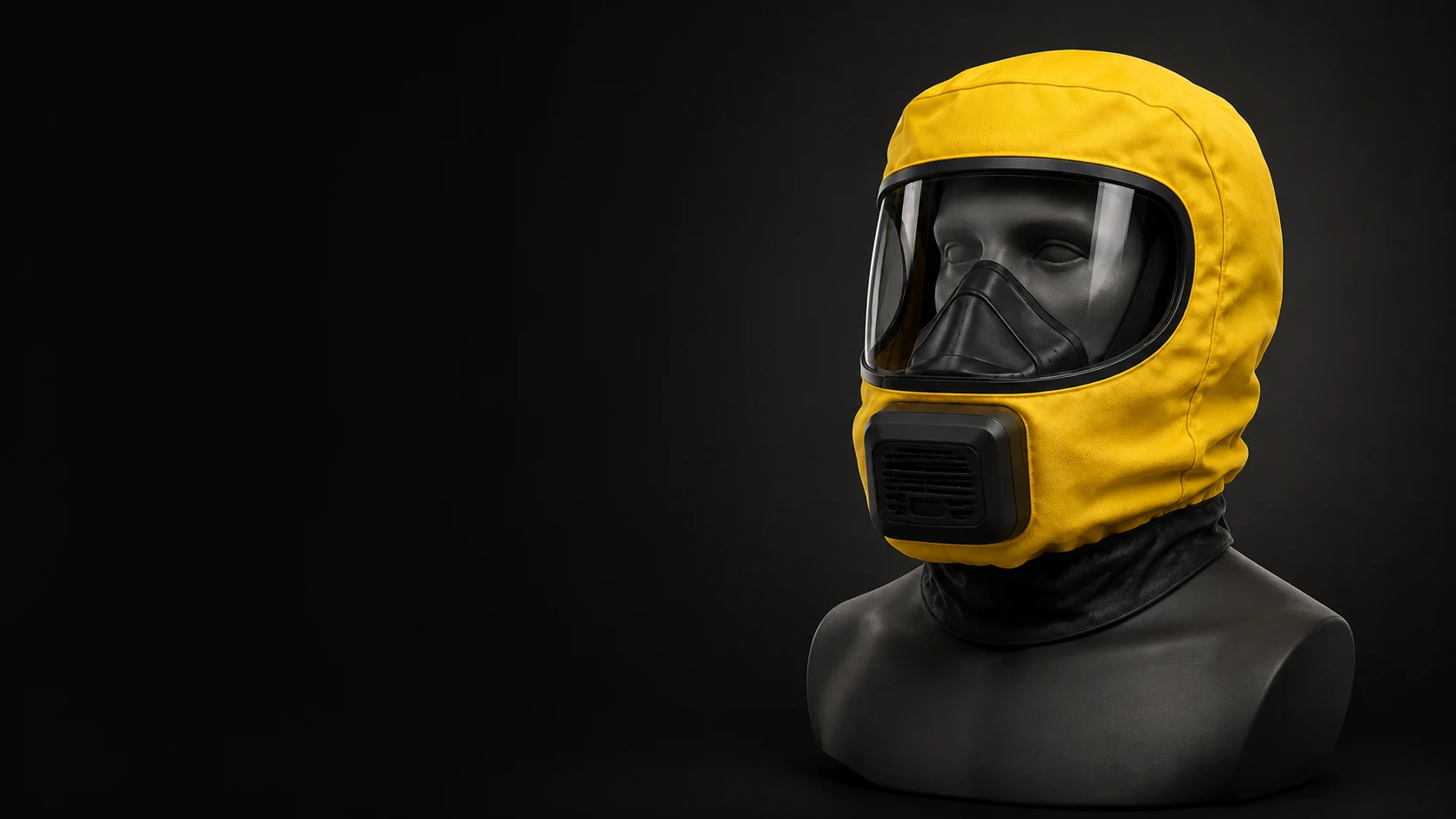
FRESH / Passive escape hood in development
Developing a passive escape hood.
Designing the readiness around it.
From the places we call home to the places we build tomorrow, respiratory readiness deserves better design. We’re developing a considered family of respiratory products, storage and training concepts—with people at the centre.
02 / THE COLLECTION
Five families. Clearly defined.In developmentPassive escape hood — in development
Our lead passive escape-hood programme. Exploring more room for different head and hair profiles, intuitive retention and a clearer first-use experience.
Concept illustration. Protective performance unvalidated.
These are development programmes, not products available to order. Each respiratory category has different capabilities and limitations.
See the family differencesChoose a family to explore its programme. This comparison explains categories; it does not recommend equipment for a particular hazard.
| Family | What it explores | Current stage | Keep in mind |
|---|---|---|---|
| Passive escape-hood design | In development | Fit, retention and protective performance need validation. | |
| Powered respiratory design | Bench research | A fan does not provide an independent oxygen supply. | |
| An independent breathing-air source | Future development | A separate architecture; no product duration established. | |
| Everyday particulate respiratory design | Concept development | Not presented as a fire-gas escape product. | |
| Storage, retrieval and familiarisation | In development | An inert trainer offers no protection. |
UNDERSTAND THE DESIGN
The filter, the face interface and the retention system do different jobs. Here’s the principle behind the concept—and what we still need to prove.
A particle filter captures particles. Gases and vapours need filters specified for those substances. A filter does not supply oxygen.
In the FRESH concept, the inner cup is intended to seal around the nose and mouth. The straps would hold it against the face; tightening the outer hood alone does not establish that seal.
The filter, connections, seals and exhalation path must work together. Leakage, breathing resistance and exhaled-air clearance need testing on the final assembly.
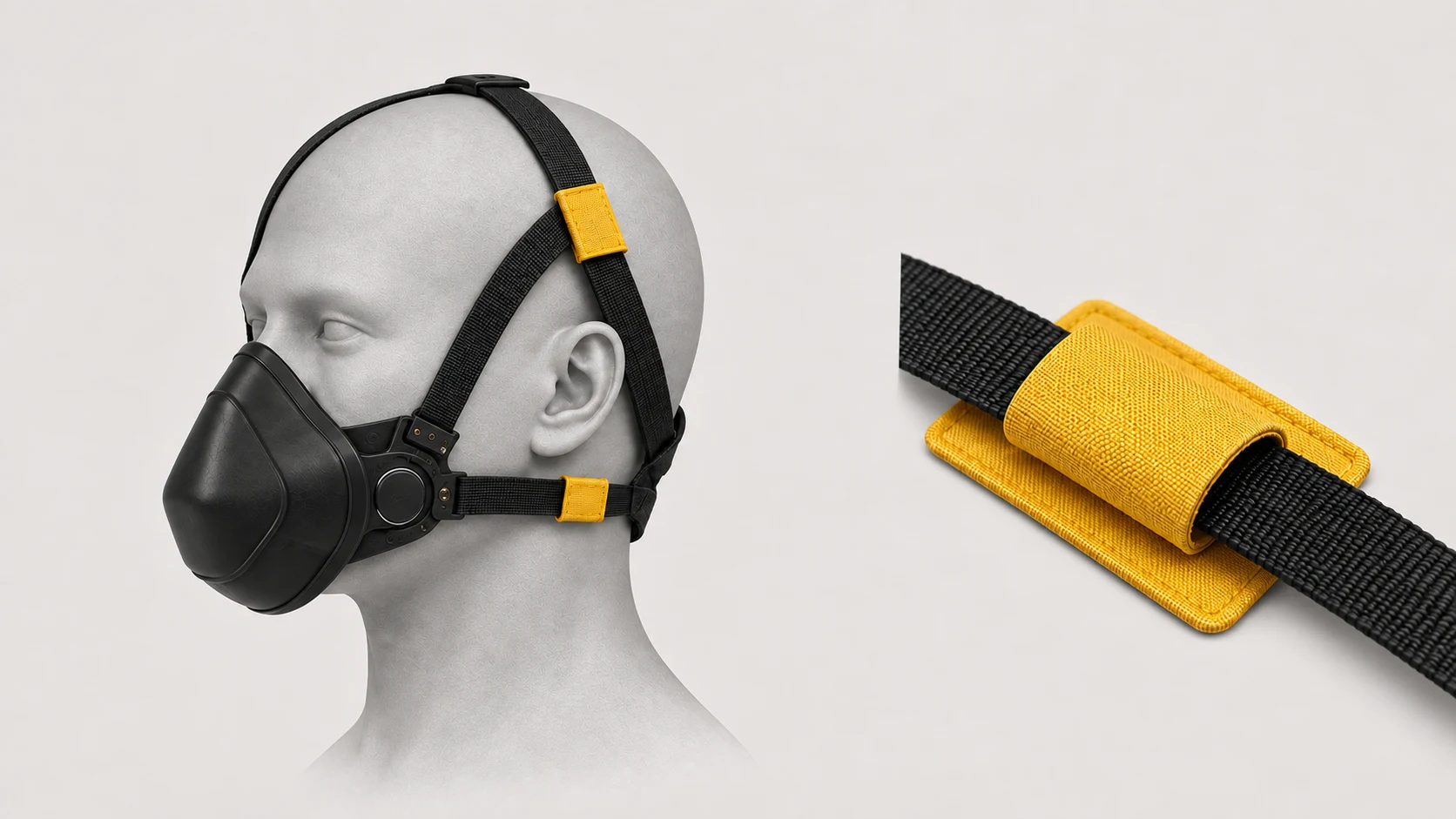
Retention would load the cup-support structure. The yellow sleeves shown here are proposed strap guides; they are not a substitute for a validated attachment or face seal.
Extra crown and rear volume could accommodate more head and hair profiles. Preconnected straps aim to reduce handling steps. Both ideas need diverse-user fit and timed handling trials.
A powered filtering respirator uses a battery-driven blower to move air through its filters. For FAYAMASK Assist, airflow, heat, battery behaviour and breathing resistance after a power failure are separate bench-research questions. No runtime or safe fallback performance is established.
Independent Air is a different future programme, exploring an independent breathing-air source. Adding a fan to a filtering hood does not create that source.
Read NIOSH’s explanation of powered air-purifying respirators ↗Category explanation and design study, not fitting instructions or an escape procedure. Equipment selection depends on the wearer, task and environment. HSE respiratory-protection guidance ↗
03 / DESIGNED AROUND PEOPLE
A hood is only part of the story.
How it fits. How it feels.
How it is understood.
We’re investigating headroom, preconnected retention and simpler handling. Physical samples and independent testing must turn those design intentions into evidence.
01 Room for real people
02 Fewer things to figure out
03 Evidence before claims
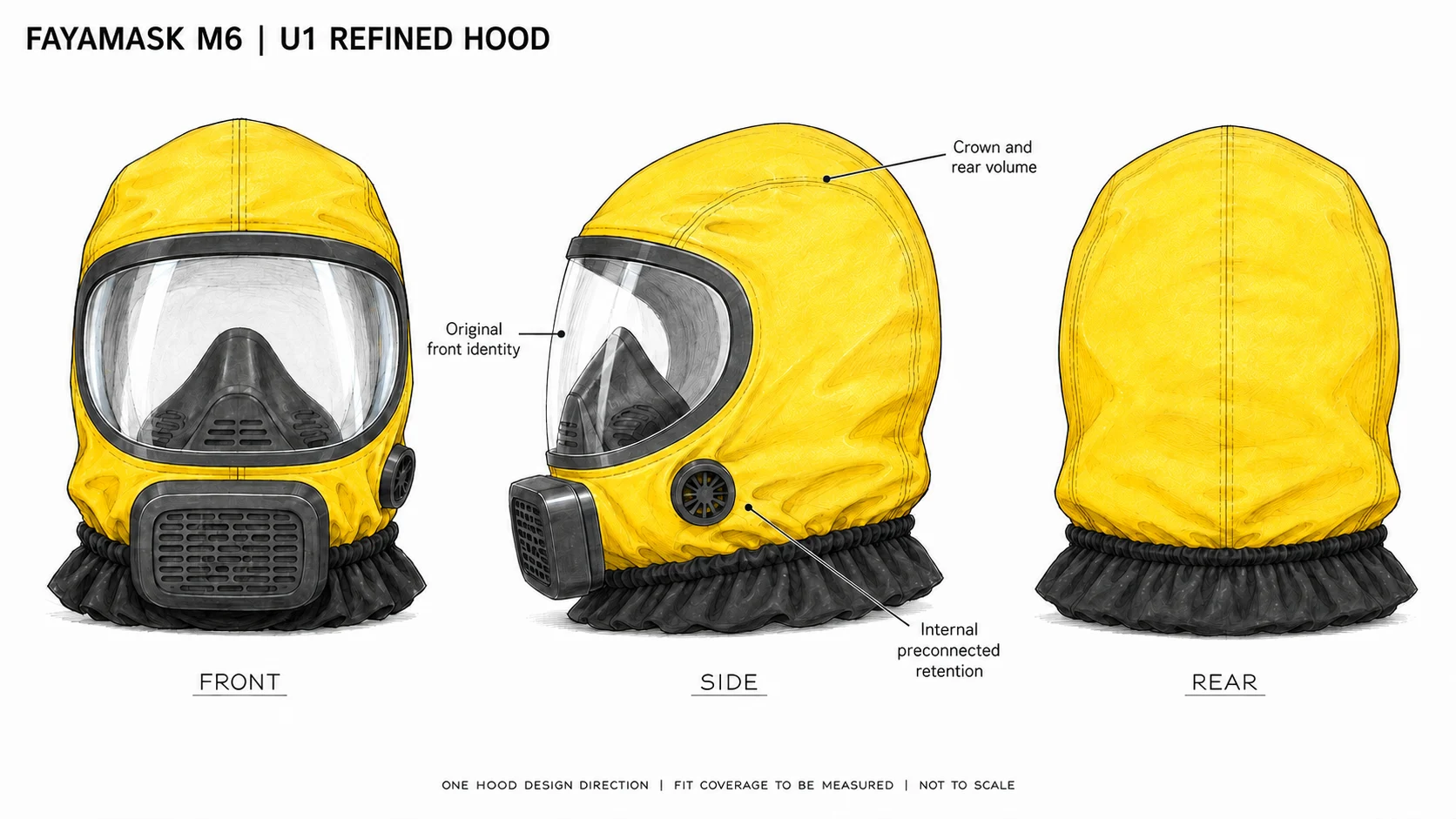
Open the interactive study, or view the static illustration above.
Earlier concept-envelope model. Not the latest hood geometry, a complete breathing assembly or manufacturing CAD.
THE DESIGN NOTEBOOK
Explore the assembly, the training companion and the information around the product. Each image shows a design idea, with the open questions alongside it.
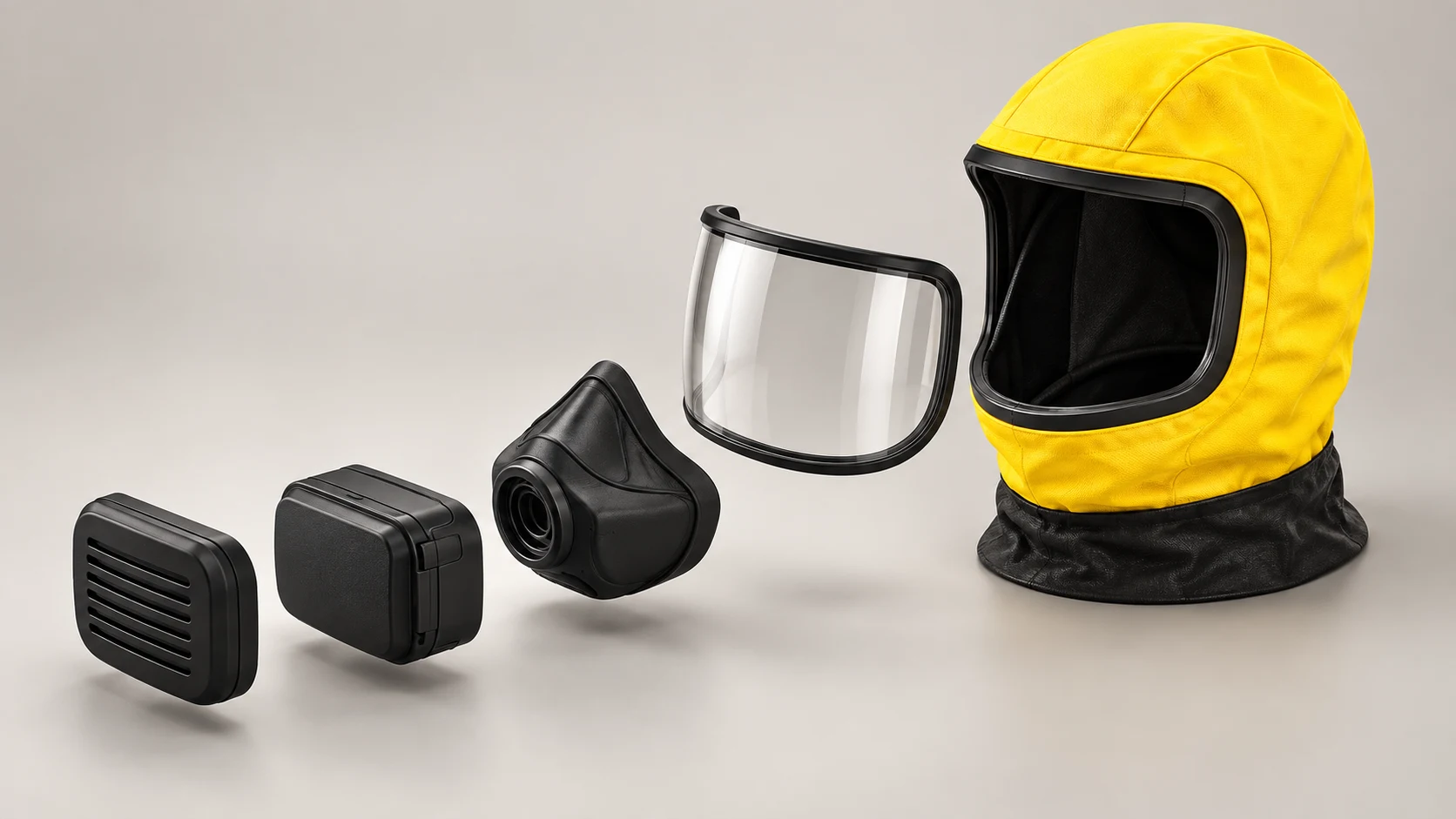
The canopy, visor, inner cup and respiratory assembly have distinct roles. The respiratory core is shown as a single closed unit; its final configuration remains under review.
Regenerated appearance study. Connections, seals, retention and internal airflow are not fully represented. Separation is illustrative, not an assembly sequence or manufacturing drawing.
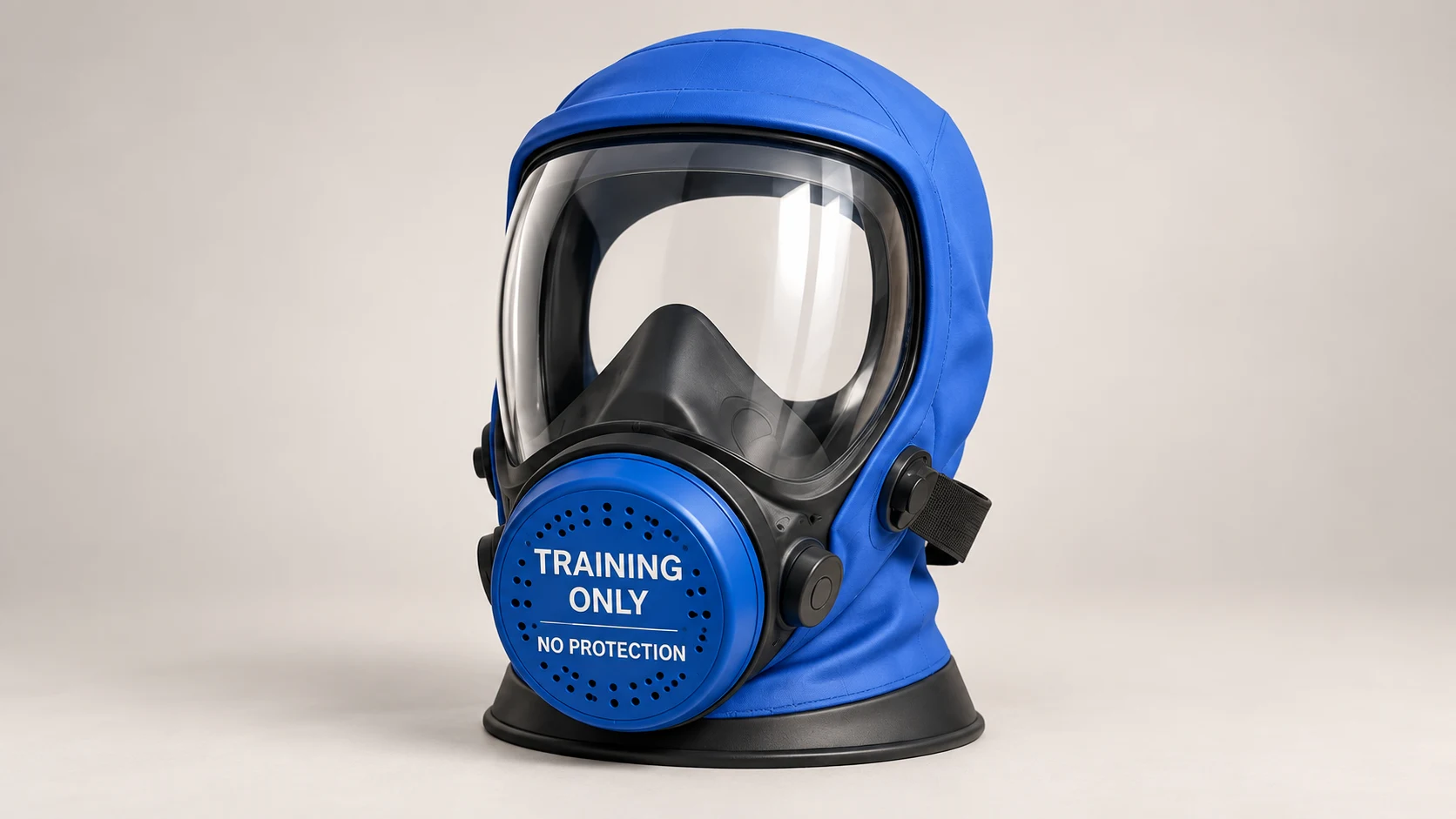
A blue familiarisation companion, visibly separate from the yellow hood. The front marking says exactly what it is: training only, no protection.
Regenerated appearance study. Breathing comfort, fit, cleaning, durability and training equivalence require evaluation. No timed donning or unrestricted-breathing claim is made.
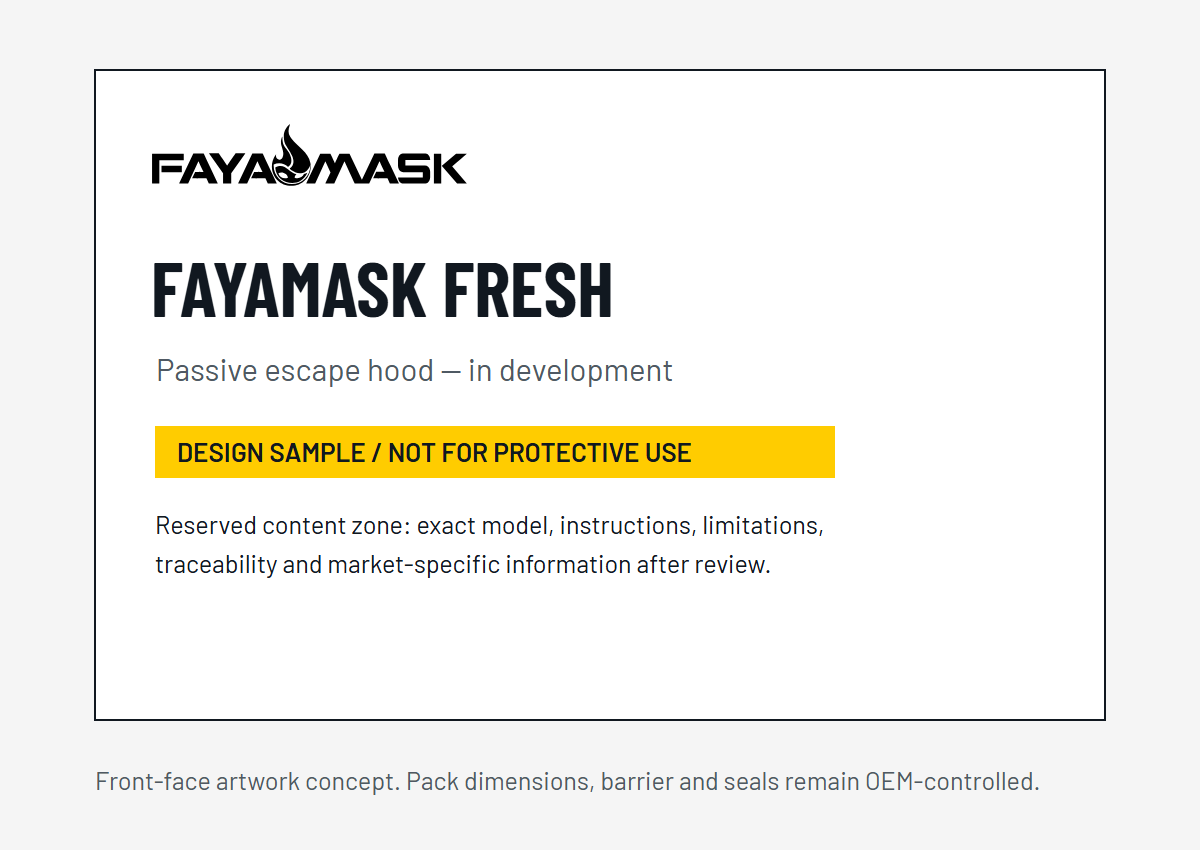
The approved primary identity, a clear category and unmistakable sample status. Information design belongs alongside the product design.
Original front-face artwork concept. Pack dimensions, barrier performance, seals, traceability and market-specific instructions still need definition. This is not released packaging.
04 / BEYOND THE PRODUCT
Easy to locate.
Familiar before it matters.
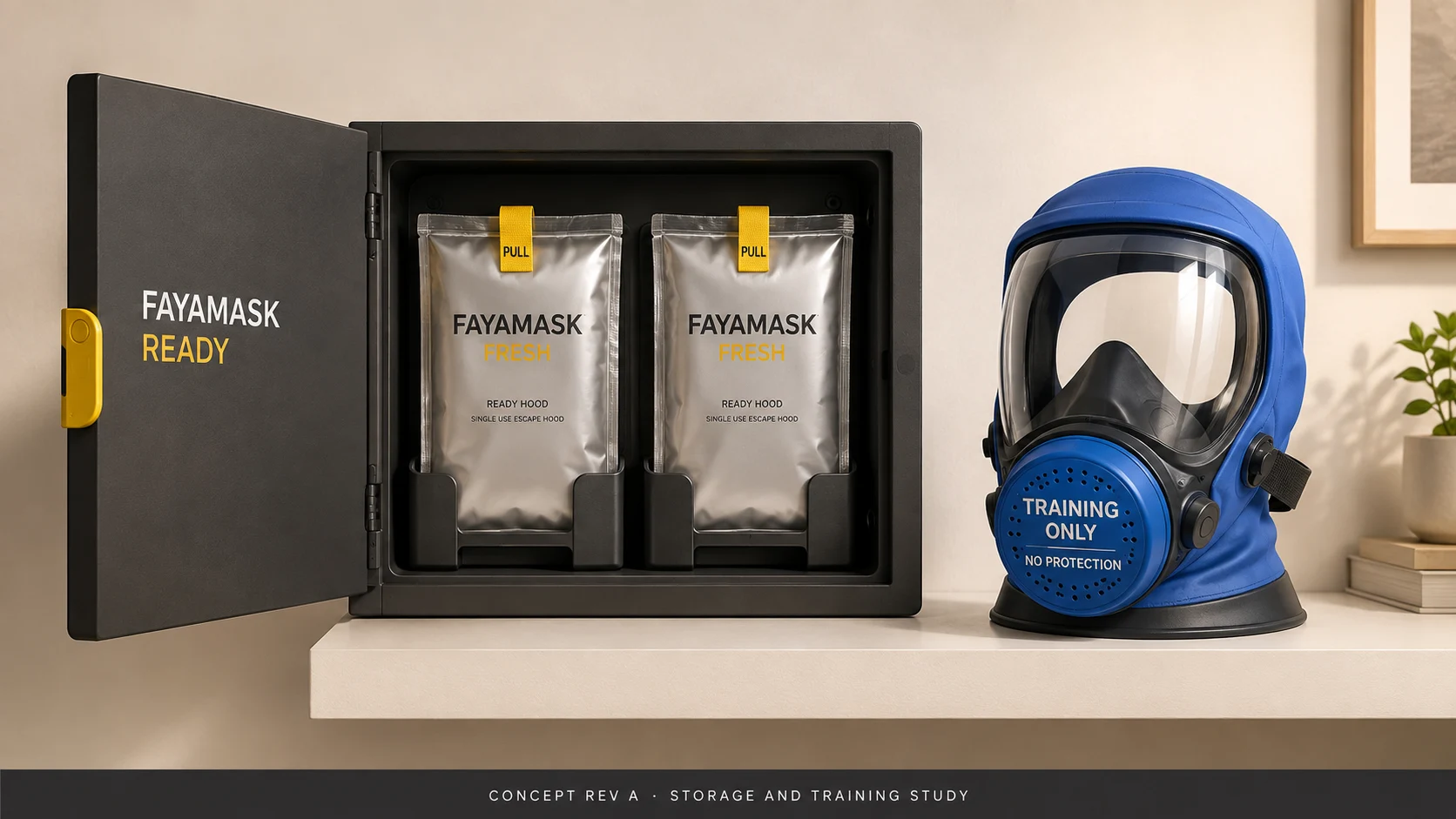
Storage, training and readiness support — in development.
We’re exploring equipment storage, clearly inert familiarisation trainers and readiness support. The illustration shows a two-pack layout idea; cabinet dimensions, pack capacity and retrieval have not been validated.
A retrieval ribbon and a wider side-access opening are proposals for handling trials. Actual sealed-pack dimensions, grip clearance and opening forces must inform the cabinet design.
A blue, clearly labelled inert trainer would support familiarisation without opening a protective unit. It provides no protection; training content and durability need their own review.
A QR or NFC identifier could link equipment to manually maintained inspection and renewal records. Scanning an identifier would not establish that a respirator is safe, in date or ready for use. No live monitoring service is offered here.
THE OFFER WE’RE BUILDING
A focused FAYA programme, with room for carefully selected partner products and services as each offer is verified.
Our near-term focus: the passive hood programme, an unmistakably inert training companion and practical storage.
Explore readiness ↗We’re evaluating a small range of respiratory and preparedness essentials, such as particulate RPE, first-aid kits, fire blankets and lighting.
Exact models and suppliers are not selected for sale. Partner products would retain their actual manufacturer identity.
Readiness records, equipment renewal support and referral to competent respiratory fit-support providers are service directions under consideration.
05 / BUILT THROUGH CONVERSATION
Facilities teams, procurement buyers and individuals bring different questions. Start with your setting, country and evidence needs; we’ll prepare a conversation around them.
For facilities, employers and distribution partners exploring future respiratory readiness. Tell us about your setting, procurement needs and training priorities.
06 / FROM DESIGN TO EVIDENCE
FRESH leads our development focus. Illustrations help us discuss the idea; physical samples and product-specific evidence must establish what it can do.
Discuss a development partnershipConcept illustrations, candidate materials and digital display geometry support discussion. They do not establish a functional protective prototype.
Obtain documented OEM baselines and evaluation samples. Measure display-part fit separately from respiratory performance.
Resolve materials, joints and seals; test fit, handling, leakage, breathing resistance and thermal behaviour on the actual configuration.
Establish conformity assessment, instructions, traceability, production controls and aftercare before making protective claims or taking orders.
A development sequence, not a completion forecast. Assist needs its own powered-system engineering and assessment. The inert trainer and storage enclosure require separate evaluation.
BEFORE YOU ENQUIRE
Understanding the category is the first step. Product selection needs evidence specific to the device, the user and the intended environment.
The owned products shown here are in development and are not available to order through this site. You can discuss the programme or a potential partnership; an enquiry is not a purchase or sample reservation.
No. Particulate, passive escape, powered and independent-air systems are different categories. A filtering respirator does not supply oxygen. Suitability must be established for the exact equipment and intended use.
Read HSE guidance on respiratory protective equipment ↗Headroom at the crown and rear, canopy fit and preconnected retention are design priorities. They need trials with a diverse group of users. More space alone does not prove a face seal, and we do not claim universal fit.
It illustrates an inert familiarisation trainer: no protection. Its purpose would be to support reviewed training before an emergency, with clear separation from protective equipment.
Your country, setting, intended users, procurement questions and the support you want to explore. You do not need to share confidential site plans or personal health information. We do not calculate an equipment plan automatically.
No. It prepares an email locally for you to review, edit and send from your own email service. You can also copy the text. Opening your email app does not confirm delivery.
The future starts with a conversation
Building partnerships in product development,
distribution and respiratory readiness.